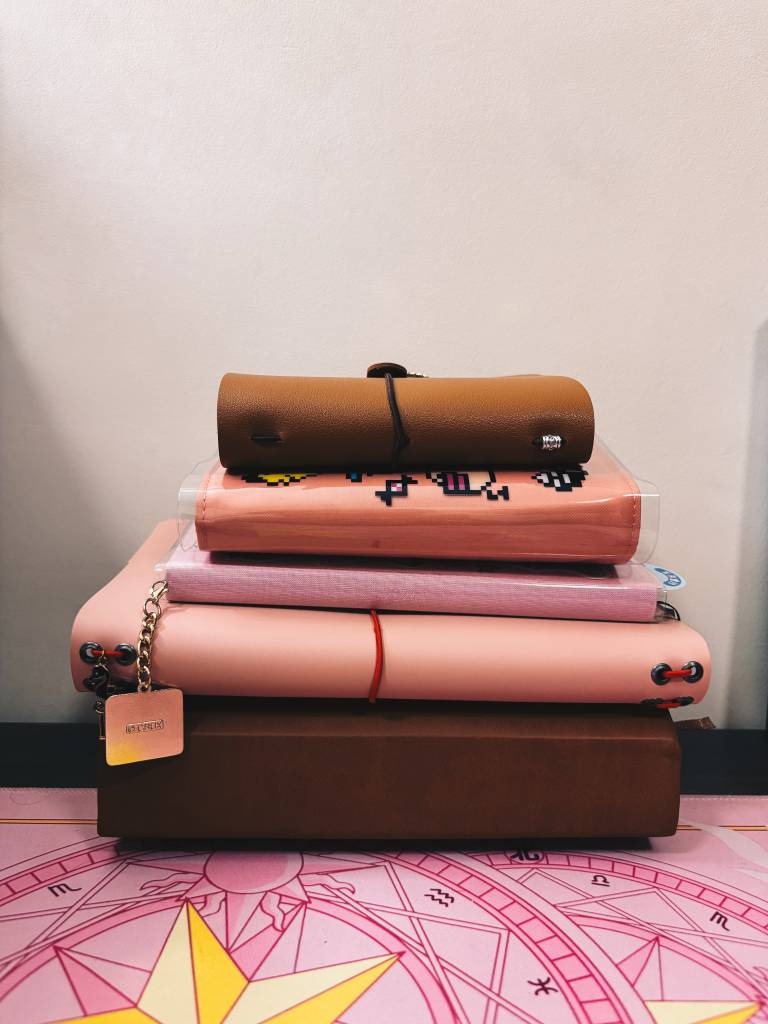
For some people, journaling begins with buying a pretty notebook.
For me, it started as homework.
Back in elementary school, we had to write journal entries every single day for an entire school year. At the time, I didn’t think of it as self-expression or memory-keeping. It simply felt like another requirement to finish before class—another notebook to bring around, another assignment to complete alongside spelling tests, projects, and homework. I definitely didn’t expect that years later, I would still be journaling, except now completely by choice.
Looking back, though, maybe the signs were already there.
Even before journaling became shelves of filled notebooks, carefully chosen pens, sticker collections, and elaborate spreads, I was already the kind of little girl who collected lock-and-key diaries. You know the ones: tiny notebooks with tiny keys that somehow convinced us our deepest secrets were completely protected.
Those pages contained everything that felt important at the time—friendship drama, embarrassing moments at school, celebrity crushes, favorite songs copied from the radio, and overly dramatic declarations about terrible days that probably weren’t actually terrible. Looking back now, most of those entries would probably make me laugh, but at that age, those things genuinely felt huge.
Around the same time, I also became obsessed with As Told by Ginger. There was something about watching someone process life through journal entries that completely fascinated me. The show somehow made ordinary experiences feel important enough to document. Awkward moments, friendship problems, confusing emotions, bad days at school, and random everyday experiences suddenly felt less like meaningless moments and more like pieces of a larger story.
Without realizing it, I slowly started treating my own life the same way.
What started as homework gradually became habit, and eventually that habit turned into something much bigger. Journaling stopped being simply a place to record what happened during the day and became somewhere I could process difficult thoughts before I fully understood them. It became somewhere to celebrate small victories that felt too insignificant to mention to other people and somewhere to store thoughts that felt too messy to say out loud.
As I got older, journaling served different purposes depending on what stage of life I was in. Sometimes it became memory keeping. Sometimes it became emotional processing. Sometimes it became creative play. Sometimes it simply became the thing helping me survive stressful periods.
Of course, not every page was meaningful.
Some pages were messy. Some were mostly doodles. Some had grocery lists sitting beside emotional breakdowns. Some pages simply documented things I liked at the time—favorite songs, favorite movies, favorite foods—as if I was trying to preserve evidence of who I was before inevitably changing again.
Maybe that’s because growing up is strange. You rarely notice yourself changing while it’s happening. You don’t realize certain friendships are quietly becoming memories or that routines you barely think about will eventually become nostalgia. Most of the time, becoming a different version of yourself happens so gradually that you only notice when you look backward.
Life moves quickly in that way. Days blur together, weeks disappear, and entire seasons of your life quietly pass before you realize how much has changed. I think journaling became my way of slowing things down and giving ordinary days somewhere to exist beyond memory.
Now when I flip through old journals, it feels less like reading notebooks and more like opening tiny time capsules. Inside them are previous versions of myself: the girl stressed about school projects, the teenager navigating friendships, the version of me writing about dreams that felt impossibly far away, the version of me struggling through difficult periods, and the version of me celebrating things she once thought would never happen.
Sometimes reading old entries makes me laugh. Sometimes it makes me cringe. Mostly, though, it makes me grateful because without journaling, many of those versions of myself would probably be gone.
Maybe that’s what journaling shaped the most—not simply the habit of writing things down, but the habit of paying attention. It taught me that ordinary days eventually become memories too, which is probably why I still keep writing after all these years.
Not because every day is extraordinary, but because ordinary days deserve somewhere to stay.